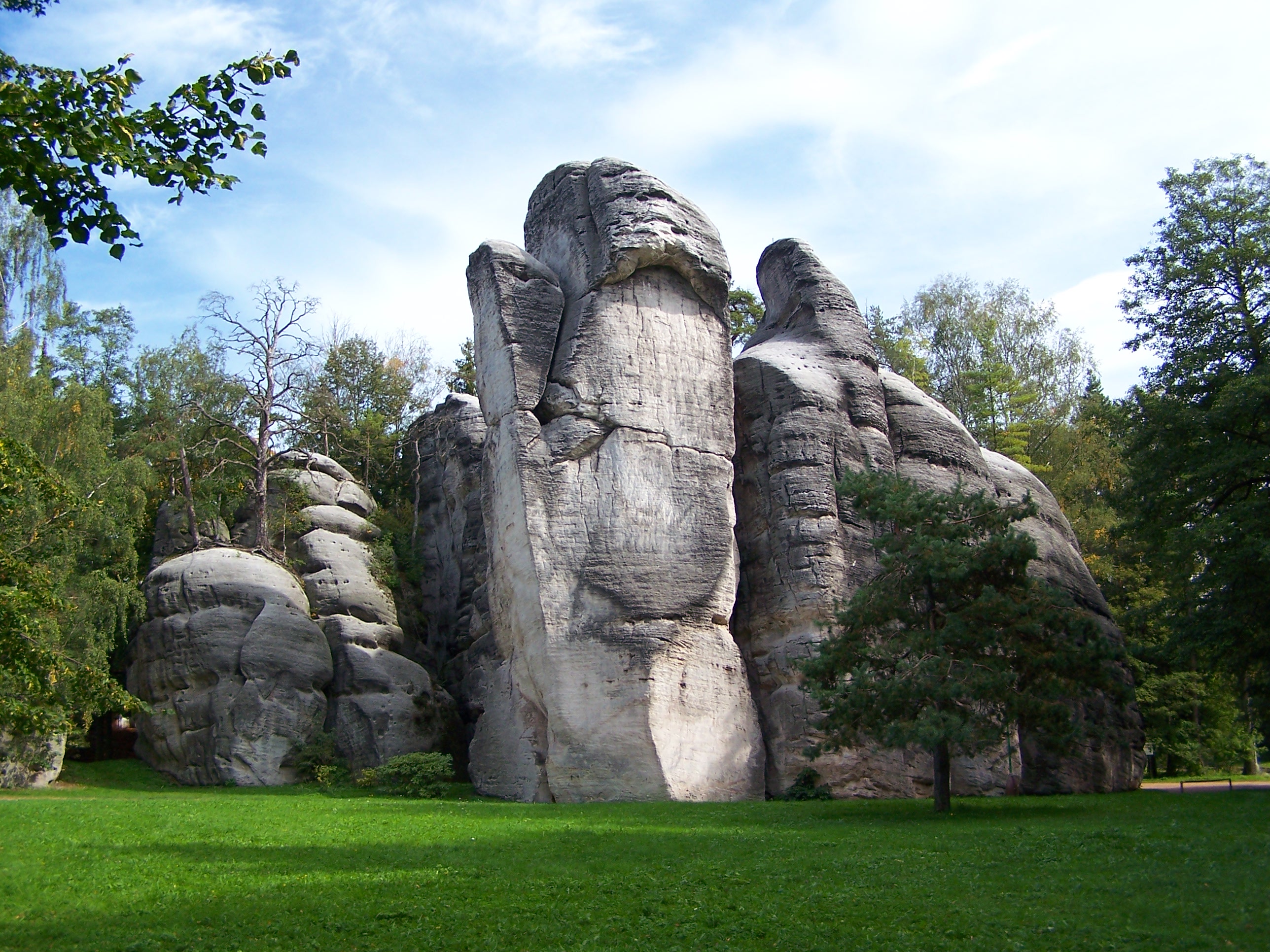
The Prachov Rocks sit roughly 5 kilometres southwest of Jičín in the Liberec Region, at the western edge of the Bohemian Paradise UNESCO Geopark. Geologically, they belong to a broader sandstone massif deposited during the Cenomanian and Turonian stages of the Upper Cretaceous — approximately 93 to 89 million years ago. At that time, a shallow epicontinental sea covered most of what is now northern Bohemia. The sediment that accumulated on its floor is the material now exposed as vertical pillars, narrow canyons, and curved overhangs.
Geological Background
The dominant lithology is fine- to medium-grained quartz sandstone with calcareous cement. This cement, deposited in thin horizontal bands, controls the fracture pattern of the rock — weathering follows vertical joint systems, producing the characteristic tower-and-fissure morphology. The colour gradients visible on the cliff faces reflect changing iron content in the original sediment: rust-orange zones indicate goethite precipitation, while pale grey zones mark areas where iron was leached by circulating groundwater after deposition.
The overall plateau drops from around 380 metres above sea level at the central ridge to approximately 310 metres at the forest floor. Differential erosion between harder and softer sandstone beds accounts for the irregular skyline of the formation — harder caprock layers protect the columns from above while softer material erodes laterally, undercutting the towers and eventually causing block falls that reshape the canyon floor.

Trail Network and Access
The Czech Tourist Club (KČT) maintains four colour-coded routes through the rocks. The standard circuit — red trail — covers approximately 3.5 kilometres and takes between 90 minutes and two hours at a measured pace. It includes the Záborský Viewpoint, the Knights' Passage, and the remains of the medieval Pařez Castle, which used the natural rock as part of its defensive structure in the 14th century.
A less-visited green trail to the north skirts the edge of the formation and descends into the Vesec valley. This route is useful in wet conditions, when the main circuit passages become slippery. Metal handrails and carved steps assist on several steep sections along all marked routes.
Practical Information
- Entrance fee: Adults 120 CZK, children 60 CZK (2025 tariff; verify at gate)
- Opening hours: April–October, daily 08:00–18:00; closed November–March
- Nearest parking: Prachov village, coordinates approx. 50.390° N, 15.317° E
- Public transport: Bus from Jičín bus station (line 460) to Prachov, stop Prachov, Skály
- Dogs: Permitted on leads on the outer trail only
Rock Climbing
Prachov is one of the older climbing areas in Bohemia, with the first documented ascents dating to the 1880s. The Czech climbing ethics that developed here — which prohibit the placing of permanent metal protection on natural rock — remain in force today under Czech Mountaineering Club (HK) regulations. Climbers must register at the entrance and are required to use fibre friction knots rather than metal camming devices on the sandstone, which is too soft and porous for reliable metal protection placement.
The Czech Mountaineering Union (Horosvaz) publishes an updated guidebook to the routes at Prachov, covering over 400 lines ranging from IV (beginner) to X (elite). The majority fall between VI and VIII on the Czech scale.
Flora and Fauna on the Rock Plateau
The sandstone environment supports a specific acid-tolerant plant community. Heather (Calluna vulgaris) and bilberry (Vaccinium myrtillus) dominate the exposed plateau, while mosses of the genus Polytrichum carpet the shaded canyon floors. Several nationally protected fern species — including Asplenium septentrionale — grow in rock crevices. The Eurasian nuthatch (Sitta europaea) and treecreeper (Certhia familiaris) are resident birds; peregrine falcons (Falco peregrinus) use the taller towers for nesting between March and July, during which time specific columns are closed to climbing.
Conservation and Site Management
Prachov Rocks fall within the Bohemian Paradise Protected Landscape Area (CHKO Český ráj), designated in 1955 and expanded in 2002. The Nature Conservation Agency of the Czech Republic (AOPK ČR) manages trail maintenance, visitor limits, and the seasonal climbing closures. The 2023 management plan set a daily visitor cap of 1,200 people for the main circuit to reduce compaction damage on the sandstone floor of the narrow passages.