The Adrspach–Teplice Rocks (Adršpašsko-teplické skály) occupy roughly 1,770 hectares in the Broumov Highland of northeastern Bohemia, approximately 15 kilometres east of Náchod near the Polish border. The formation divides into two distinct sections: the Adrspach Rock Town to the north and the Teplice Rock Town to the south. Both are within the Adrspach–Teplice Rocks Nature Reserve, one of the most strictly protected geological areas in the country.
Stratigraphy and Rock Age
The sandstone belongs to the Jizera Formation and the Bělohrad Formation of the Upper Cretaceous (Turonian and early Coniacian stages), dated to approximately 89–86 million years ago. The sequence was deposited in a shallow-marine to lagoonal setting. Grain size varies from fine (0.1–0.25 mm) in the lower beds to medium (0.25–0.5 mm) in the upper sequence, reflecting changes in water energy during deposition.
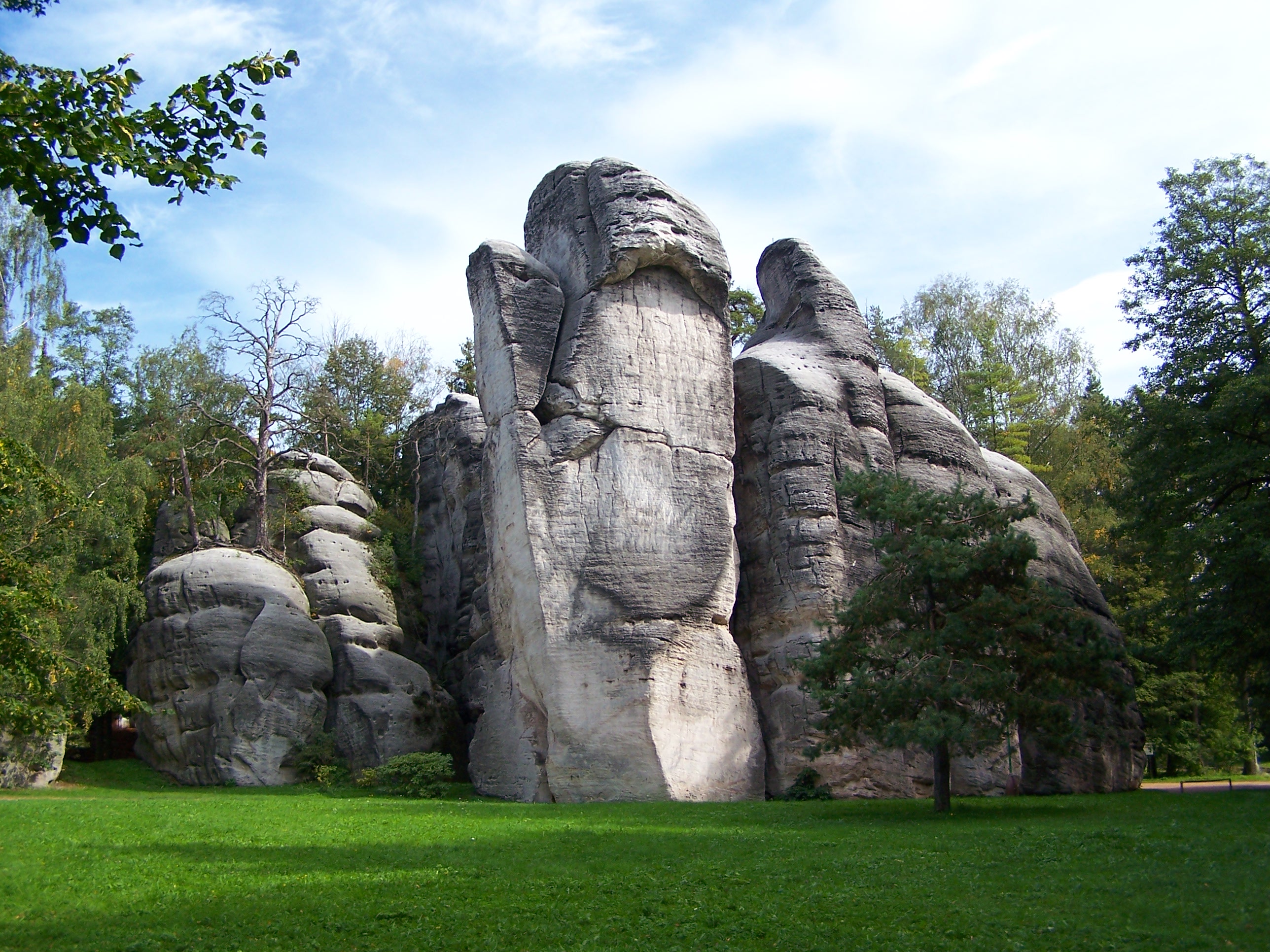
Cementation is predominantly siliceous in the Teplice section, making those rocks harder and more resistant to erosion than the calcareous-cemented equivalent at Adrspach. This difference explains the contrast in tower height: Teplice towers typically reach 40–60 metres, while Adrspach towers rarely exceed 35 metres but are more densely spaced.
Erosion Mechanisms
Three processes have shaped the current morphology. First, differential weathering along vertical fracture sets created the initial tower outlines. Second, frost action during multiple Pleistocene glacial periods widened joint gaps and detached block sequences, producing the angular talus fields visible at the base of many towers. Third, ongoing groundwater movement continues to dissolve calcareous cement, particularly in rock near stream channels — the Adrspach stream cuts through the northern section and accelerates local undercutting.
The Two Rock Towns Compared
Adrspach Rock Town
The Adrspach section centres on a small glacially influenced lake — Velké jezírko — which drains into the Metuje River. The main tourist circuit is approximately 2.5 kilometres and loops through the densest concentration of towers. Several named formations stand out: the Lover's Rock (Milenci), a naturally formed arch; and Strážce (The Guardian), a free-standing pillar roughly 30 metres high visible from the entrance plateau.
Teplice Rock Town
The Teplice section is larger and less frequently visited. The circuit here extends to approximately 4 kilometres and includes the Sigismund Falls — a 12-metre cascade dropping over a sandstone ledge — and an area known as the Stone Gate (Kamenná brána), where erosion has produced a natural passage between two leaning towers. Access to certain parts of the Teplice section requires a local guide permit during the May–July nesting season.
Visitor Access and Conditions
- Entrance fees: Adrspach: adults 130 CZK; Teplice: adults 130 CZK (2025 tariff)
- Combined ticket: Both sections, valid 2 days: 200 CZK
- Railway access: Direct train from Trutnov to Adrspach station; the trailhead is 400 metres from the station building
- Best conditions: Weekday mornings in May, September, or October; summer weekends attract high visitor volumes
- Weather note: Fog is common in the rock canyons in the morning from October through March; trails remain open but viewpoints lose visibility
Sandstone Climbing
Adrspach–Teplice is the largest sandstone climbing area in the Czech Republic by number of recorded routes. The Czech Mountaineering Union database lists over 1,100 documented lines across both sections. The climbing rules here are among the most detailed in Central Europe — only natural fibre ropes and friction knots are permitted for protection; chalk is banned to protect the surface patina; and all routes must dry completely before climbing is allowed after rain (typically 48 hours for south-facing lines, up to 72 hours for north-facing).
Notable formations for climbing include the Teplice section's Jehla (The Needle) — an isolated pillar of approximately 45 metres with several routes graded VI to IX — and the Adrspach Giant (Obr), a broad flat-faced tower that hosts several multi-pitch lines.
Research and Monitoring
The Czech Geological Survey (geology.cz) has monitored block fall events at Adrspach–Teplice since 1998. Data from the monitoring network shows an average of 3–5 significant block detachment events per year, predominantly in late winter when freeze-thaw cycling peaks. A seismic sensor array installed in 2019 provides real-time data to the AOPK ČR management office in Náchod.

